Your Journey to Home

Buying a home is more than a transaction; it is the beginning of a new chapter. It is where your mornings will start, where memories will quietly build over time, and where you create a true sense of belonging. It is natural to fall in love with a space the moment you walk in, drawn to the light, the details, and the feeling it gives you, but a home should offer more than just a beautiful first impression. It should feel right not only emotionally, but also in the way it supports your everyday life.
That is why it helps to slow down and look a little deeper. Beyond the charm and staging, every home has its own story, revealing how it has been cared for, how it will function for you, and how well it will hold up over the years. When you understand what to look for and what to question, you are not just buying a house, you are choosing a place that truly fits you, with confidence and peace of mind.
Before you start to look for a house!
Getting A Pre-Approval
Most buyers think pre-approval is just a quick formality, but in reality, it’s where your entire buying power, credibility, and negotiating strength are decided. During a pre-approval, a lender reviews your income, credit score, debt, and assets, then tells you how much you can borrow, what your monthly payment will look like, and the price range you should realistically stay in.
It’s important to understand the difference between pre-qualification and pre-approval: pre-qualification is a quick estimate and often useless in competitive markets, while pre-approval is verified and taken seriously by sellers, especially in New Jersey, where pre-qualification alone may not even get your offer considered.
 A good lender will break down your monthly payment clearly, explain rate scenarios, prepare you for cash needed at closing, and respond quickly when you make an offer. Ask your lender questions most buyers overlook, like what your monthly payment will feel like with NJ taxes included, how much cash you’ll need upfront, what could go wrong in underwriting, and how fast they can close.
Have your documents ready early, including W-2s or tax returns from the last two years, recent pay stubs, bank statements, and ID, and if you’re self-employed, be prepared for more detailed requirements. The strongest buyers go a step further and get a fully underwritten pre-approval, meaning the lender has reviewed everything upfront, making their offer almost as strong as cash in the eyes of a seller. While this step can feel limiting, it actually provides confidence; You don’t have to guess if you can afford a home; you know you can buy comfortably.
Finding The Right Agent
Finding the right buyer’s agent is not just about someone who opens doors; it is about having a partner who steps into your shoes, anticipates problems, and helps you see the full picture of what you are buying. With over 20 years of experience as a tour guide, I have learned how to read people, understand what makes them happy, and create experiences that leave them confident and excited. I bring that same approach to real estate, combining careful strategy with a personal touch. I explore every detail of a home and every nuance of its neighborhood, making sure you understand not just the house, but the region, because in New Jersey, where you live matters as much as what you live in. I work patiently, like a lawyer protecting a client, and strategically, like a guide planning the perfect route so that when we find your home, it is a precise match for your lifestyle, goals, and comfort level. I notice what most buyers miss, ask the tough questions, and create a plan to hit the target in just a few smart steps. My goal is not just to show you houses, it is to help you discover the right town, the right community, and the right home, making the process smooth, enjoyable, and ultimately empowering.
And do not forget to check my History section, you will not believe what you will learn about New Jersey; the stories and details you’ll find there will give you a whole new perspective on where you might want to live at. I also want you to know that I prepared this entire website myself in just two months, putting the same care, attention, and dedication into it as I do when helping clients find their perfect home.
Of course, there are many amazing agents out there—especially the talented professionals from Coldwell Banker right here in our area—and I happily learn from their expertise, picking up helpful ideas along the way. If you want someone who combines that knowledge with smart strategy, a friendly approach, a little tour-guide magic, and a personality that’s always positive, with one motivation in mind—making everyone happy—then I would love to guide you to your perfect home!
Your First Step to a Home That Feels Right, Today and Every Night
- Solid roof — The roof is one of those things you don’t think about until it becomes your entire life. Ask the seller how old it is and if there’s been any repair work done. If you’re standing outside, scan it from the street — missing patches, curling edges, or shingles that appear to be failing are all telling signs. And when you’re inside, peek into the attic if you can. Any daylight coming through or old water stains up there
means the roof has been letting things in, and that’s a conversation you need to have before you go any further. The four most common roofing problems you’ll encounter when house hunting are
Curling shingles are one of the first things you can spot from the street — the edges lift, or the center buckles, which means the shingles are at the end of their life and water is getting underneath.
Missing shingles leave the underlayment exposed to the elements. Even a few missing patches can let water work its way into the roof deck and cause rot or leaks in the interior ceiling below.
Flashing failures around chimneys and vents are actually one of the most common sources of roof leaks. The metal strips that seal the gap between the chimney and the roof pull away over time, and water channels right in through that gap.
Saggingis the most serious of the four. A roofline that dips or waves instead of running straight and flat is a sign of structural damage — either the decking underneath has rotted through, or the supports holding the roof up have given way. This one goes beyond a roofing issue into structural territory and needs immediate professional assessment.
When you’re walking up to a house for the first time, just look up. A healthy roof should have a clean, straight ridgeline and uniform shingles with no obvious patches, curling, or dips. If something looks off from the driveway, it almost always is.
- No water intrusion — Water is sneaky. It doesn’t always announce itself with a big obvious stain on the ceiling. Check around window frames, crouch down and look at baseboards, feel along the walls near bathrooms and under kitchen sinks. If the drywall feels soft or the paint is bubbling anywhere, water has been there. Sellers aren’t always forthcoming about this stuff, so your hands and your eyes are your best tools here.
Water damage is the thing that catches the most buyers off guard because it rarely announces itself in one obvious place. It shows up in layers, in corners, in spots you only find if you’re actually looking. Here’s what each form of it looks like and what it’s really telling you:
Ceiling stains are usually the first thing people notice, and they’re easy to dismiss as old and resolved. Don’t. That brown ring shape forms when water soaks in and the minerals left behind as it dries. Even a faint, old-looking stain means water found its way through at some point and unless the source was definitively fixed, it will again.
Bubbling or peeling paint on walls is almost always a moisture signal. Paint doesn’t just bubble on its own. When you see it blistering or lifting away from the surface, it means water has gotten between the paint and the wall behind it — often from a slow leak inside the wall that’s been going on longer than it looks.
Efflorescence in the basement— those chalky white or grayish mineral deposits you see streaking down foundation walls — is one of the clearest signs that water is regularly moving through the concrete. The water itself evaporates, but it leaves those minerals behind on the surface. It doesn’t always mean flooding, but it does mean the basement is not dry, and over time that moisture causes real structural deterioration.
Warped or buckled hardwood floors happen when wood absorbs moisture it was never meant to hold. The boards swell, push against each other, and lift up from the subfloor. By the time you can see and feel it underfoot, the water exposure has usually been going on for a while. The subfloor underneath may be damaged too, which adds significantly to the repair cost.
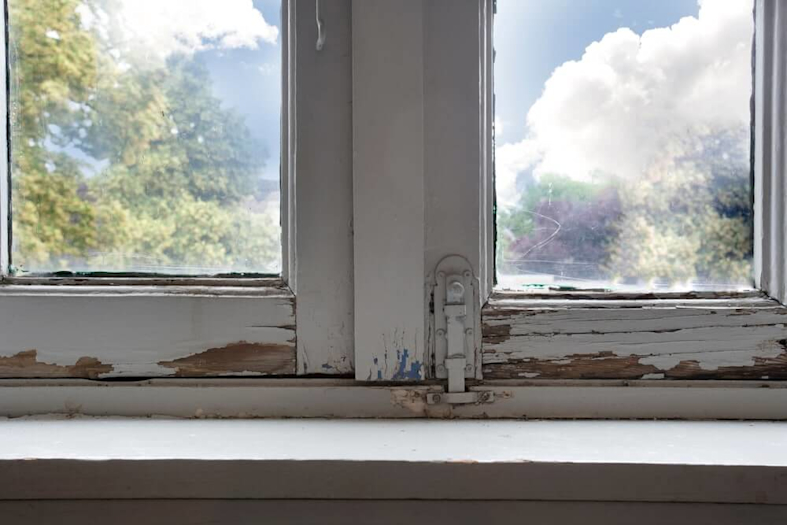
Rotting window framesare easy to overlook because they tend to be painted over and look fine at first glance. Press gently on the wood around window frames, especially at the corners and along the bottom sill. If it feels soft, spongy, or gives more than it should, the wood is rotting from moisture that’s been working its way in through failed caulk or old weatherstripping. Left unaddressed, that rot spreads into the surrounding wall structure.
A stain that looks old and dry on the surface can be hiding active damage, rot, or mold behind the drywall. Get your inspector to probe it, and if you’re still not comfortable, ask for a moisture test. The cost of that peace of mind is nothing compared to finding out six months later that the problem never actually went away.
- Even, level floors and straight walls —
Walk through every room slowly, ideally without shoes so you can feel what’s happening underfoot. A floor that noticeably tilts to one side, or a wall that appears to lean when you step back and look at it, is the house telling you something may be structurally off. Some settling in an older home is normal and not a cause for panic, but if the slope is obvious without even trying to detect it, it’s worth having a structural engineer take a closer look before you commit.
Now, take a careful look at the basement walls or the exterior foundation. Thin, vertical hairline cracks are common as concrete cures and are usually not a concern. What you want to watch for are horizontal cracks running across a block or poured concrete wall—these can indicate pressure from the soil outside, which may point to a structural issue. Stair-step cracks running diagonally through brick or block deserve the same level of attention.
When in doubt, bringing in a structural engineer is money extremely well spent.
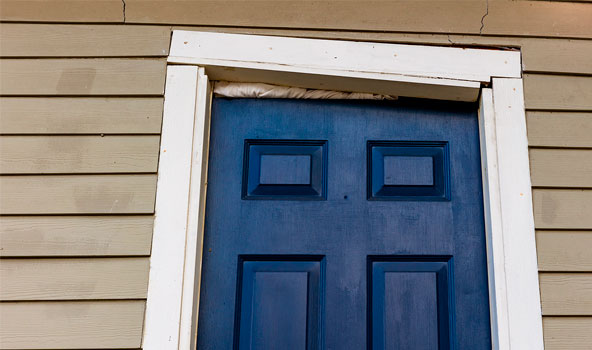
Sticking Doors and Windows are one of the most overlooked structural clues in a home. Every door and window is essentially a rectangle set into the framing. When that frame shifts—whether from foundation settling, structural movement, or changes to load-bearing walls—those rectangles fall slightly out of square.
That’s when you’ll notice the signs: a door that drags along the floor, won’t latch properly, or a window that feels stiff and refuses to open smoothly.
Take the time to open and close every door and window in the house. If more than one or two are sticking or catching, it’s rarely just humidity. It’s often the house signaling that something has moved.
- Updated systems — Nobody talks about the furnace when they’re falling in love with a house, but you should. Write down the age of the HVAC, the water heater, and the electrical panel while you’re there. A furnace that’s pushing 20 years or a water heater that’s been in the basement since the previous owners moved in are things you’re going to be dealing with sooner than you think. They’re not necessarily dealbreakers, but they’re real money, and you should factor that into what you offer.
- Natural light and sensible layout
Try to visit the house at more than one time of day if you can swing it. A place thatfeels sunny and warm at 11am can feel surprisingly dim and closed-in by 4 in the afternoon depending on which way it faces. And think honestly about how your family actually lives, not how you imagine you’d live in a nicer version of your life. If you work from home, is there a real quiet space for that? If you cook every night, does the kitchen actually connect to the rest of the house in a way that makes sense?
- Good neighborhood — The listing photos will always show the house at its best, but the neighborhood is something you have to go experience yourself. Drive through on a regular weekday morning, and then again on a Friday night.
If you see a neighbor outside, say hello — people who live there will tell you more in five minutes than any online research will. Look up school ratings, figure out how far you’d be from a grocery store, and do a quick search to see if there are any major construction or zoning changes planned nearby that could change the feel of the area. If you drive through the neighborhood and notice several homes for sale at the same time, or multiple properties that look like nobody’s been maintaining them, it’s worth asking why. It could be coincidence, or it could be a signal of broader economic stress in the area that will make it harder to sell your home down the road and could keep your property value from growing the way you’re hoping.
- Ample storage — Open every door you see. Every closet, every cabinet, every door that might be hiding something useful. People consistently underestimate how much storage they actually need, and it’s one of those things that’s very hard to add after the fact. If the house looks spacious but every closet is tiny and there’s no garage, no basement, and no attic to speak of, you’re going to feel it within the first six months of living there.
- Full permit history and clean title — Any significant work that’s been done on the house — finishing the basement, adding a bathroom, building a deck, rewiring — should have a paper trail. Ask your agent to pull the permit history. If work was done properly and legally, the permits will be there. A clean title means nobody else has a legal claim to the property, which sounds obvious but matters more than people realize when you’re sitting at the closing table. This is easy to miss because a finished basement or a converted garage can look completely normal. Nice flooring, recessed lighting, the whole thing. But if that work was done without permits, it’s legally your problem the moment you buy the house. The city could require you to tear it out, bring it up to current code at your expense. Always check whether the work matches the permit record.
- Modern electrical panel
You don’t have to be an electrician to get a general sense of whether the electrical situation looks healthy. Open the panel door and see whether the breakers are labeled, organized, and look like they haven’t been tampered with. What you don’t want to see is scorching, breakers that are clearly jammed in sideways to make room, or anything that looks like someone just improvised their way through it. Your inspector will dig into this properly, but a quick look gives you a first impression.
- Newer plumbing — Copper and PEX pipes are what you want running through the walls. Galvanized steel corrodes from the inside over decades and will eventually strangle your water pressure before it fails entirely.
Polybutylene — common in homes built from the 70s through the 90s — has a well-documented history of cracking and failing unexpectedly, which is why it ended up at the center of major class-action lawsuits. If the home has either, it’s worth getting a quote on replacement and using that as leverage in the negotiation. Homes with outdated plumbing can also raise insurance concerns. Updated plumbing signals a “well-maintained home,” which can justify a higher asking price and smoother inspections.If a seller invests in replacing pipes, it means also she/he did not cut corners elsewhere either. It is mostly a sign of overall quality. It isn’t flashy like a kitchen, but it’s one of the upgrades that protects your investment long after the paint color trends change.
- Pest evidence — Walk the perimeter of the house and look along the base of the exterior walls for mud tubes, which are how termites travel. In the basement or crawl space, look at the wooden structural members and knock on them — hollow sounds where there shouldn’t be hollow sounds are a bad sign. Small piles of what looks like sawdust near door frames or windowsills can be frass from carpenter ants or termites. Your general inspector will flag anything obvious, but in regions where termites are common, a dedicated pest inspection is absolutely worth the extra hundred dollars. People mostly miss that pests usually mean something else is wrong first. Mice come in because there are gaps or cracks. Termites are drawn to moisture and untreated wood. Roaches thrive where there’s hidden humidity or leaks. So you’re not just spotting pests—you’re spotting the conditions that allowed them in.
- Flood zone location — This one is easy to check and surprisingly easy to overlook.
Check on FEMA’s flood map site for a fee and type in the address before you make an offer. If the home is in a Special Flood Hazard Area, you’ll be required to carry flood insurance on top of your regular homeowner’s policy if you have a federally backed mortgage, and that cost adds up fast. Even if the home doesn’t technically require it, knowing whether it’s in a flood-prone area is just basic information you should have before you commit.
- Long days on market — If a house has been sitting for 60, 90, or 120-plus days without going under contract, your first question should be why. In a healthy market, a home that’s priced right and shows well doesn’t sit around that long. Extended time on the market usually means one of a few things: the price is too high, previous buyers got spooked by something they found during inspection, or there’s something about the location or the property itself that isn’t obvious from the photos but becomes clear pretty quickly when you’re standing in front of it. It’s not always a dealbreaker, but you should go in knowing that something caused other buyers to walk away.
Your Second Step With Experts by Your Side
Keeping Every Detail Clear and Right
After you’ve explored the home and started to picture your life in it, it’s time to bring in the people who help you feel sure about your decision. No matter how careful you’ve been, there is something reassuring about having experienced professionals by your side.
An inspector looks beyond what you can see, noticing the details that might not stand out at first but could matter later. An attorney helps you understand everything you are signing, making sure you feel comfortable and protected every step of the way. Lenders and appraisers help you see the bigger financial picture, so you know exactly where you stand.
Even the little things you may have questioned, a sound, a crack, a door that does not close perfectly, are looked at with a trained eye. What felt uncertain becomes clear. What felt overwhelming becomes manageable.
This step is where everything becomes real. You are no longer just hoping you made the right choice, you begin to know it. With the right people guiding you, uncertainty fades and confidence takes its place. Every answer you receive, every detail clarified, brings you closer to a decision you can stand behind with certainty. This is the moment where your dream starts to feel secure, grounded, and truly yours.
 means the roof has been letting things in, and that’s a conversation you need to have before you go any further. The four most common roofing problems you’ll encounter when house hunting are
 Missing shingles leave the underlayment exposed to the elements. Even a few missing patches can let water work its way into the roof deck and cause rot or leaks in the interior ceiling below.
 Try to visit the house at more than one time of day if you can swing it. A place thatfeels sunny and warm at 11am can feel surprisingly dim and closed-in by 4 in the afternoon depending on which way it faces. And think honestly about how your family actually lives, not how you imagine you’d live in a nicer version of your life. If you work from home, is there a real quiet space for that? If you cook every night, does the kitchen actually connect to the rest of the house in a way that makes sense?
 If you see a neighbor outside, say hello — people who live there will tell you more in five minutes than any online research will. Look up school ratings, figure out how far you’d be from a grocery store, and do a quick search to see if there are any major construction or zoning changes planned nearby that could change the feel of the area. If you drive through the neighborhood and notice several homes for sale at the same time, or multiple properties that look like nobody’s been maintaining them, it’s worth asking why. It could be coincidence, or it could be a signal of broader economic stress in the area that will make it harder to sell your home down the road and could keep your property value from growing the way you’re hoping.
 You don’t have to be an electrician to get a general sense of whether the electrical situation looks healthy. Open the panel door and see whether the breakers are labeled, organized, and look like they haven’t been tampered with. What you don’t want to see is scorching, breakers that are clearly jammed in sideways to make room, or anything that looks like someone just improvised their way through it. Your inspector will dig into this properly, but a quick look gives you a first impression.
 Polybutylene — common in homes built from the 70s through the 90s — has a well-documented history of cracking and failing unexpectedly, which is why it ended up at the center of major class-action lawsuits. If the home has either, it’s worth getting a quote on replacement and using that as leverage in the negotiation. Homes with outdated plumbing can also raise insurance concerns. Updated plumbing signals a “well-maintained home,” which can justify a higher asking price and smoother inspections.If a seller invests in replacing pipes, it means also she/he did not cut corners elsewhere either. It is mostly a sign of overall quality. It isn’t flashy like a kitchen, but it’s one of the upgrades that protects your investment long after the paint color trends change.
 Check on FEMA’s flood map site for a fee and type in the address before you make an offer. If the home is in a Special Flood Hazard Area, you’ll be required to carry flood insurance on top of your regular homeowner’s policy if you have a federally backed mortgage, and that cost adds up fast. Even if the home doesn’t technically require it, knowing whether it’s in a flood-prone area is just basic information you should have before you commit.

1. Making An Offer
When you find “The House”, you should move fast. When it comes time to make an offer on a home in New Jersey, your agent ensures every detail works in your favor. He/She will help you determine a price that is realistic, competitive, and comfortable for your budget by analyzing recent neighborhood sales, market trends, and the property’s time on the market.
He/She structures contingencies such as inspection, financing, appraisal,attorney review, earnest money, typically one to three percent of the offer, and even suggest subtle strategies like including a personal note to make your offer stand out.
Your agent prepares all paperwork meticulously, from the New Jersey Residential Real Estate Contract to pre-approval letters and proof of funds, and navigates counteroffers with a strategic eye, making sure every decision strengthens your position. With this combination of strategy, attention to detail, and an understanding of lifestyle and community, your agent ensures your offer is not just a number on a page but a confident, smart step toward your perfect home.
The seller may accept, reject, or counter your offer. Your agent will guide you through every counteroffer, explaining what is strategic and what works best for your situation. Multiple rounds of negotiation are normal, and your agent ensures you always feel confident and in control.
2. Attorney Review
Attorney review is a unique and essential step in New Jersey that begins right after your offer is accepted, giving both buyer and seller a three business day window to hire their attorneys review the offer and the contract. During this time, the contract is not yet final, and either side can request changes, add protections, or even cancel without penalty. Your attorney carefully examines every detail, from contingencies and timelines to repair responsibilities and closing conditions, making sure nothing is vague or left open to risk. Your agent works closely with the attorney to keep everything aligned with your goals and to move the process forward smoothly. Many buyers do not realize that this is where the real negotiation often continues quietly behind the scenes, shaping the deal in your favor before it becomes binding. Once both attorneys agree and conclude the review, the contract is finalized and you can move forward with confidence into the next steps.This attorney review can take as quick as an hour to complete the review process or up to a month in extereme cases.
3. Earnest Money
Once the contract is finalized after attorney review, congratulations—you are officially under contract! From here, your agent guides you through inspection, appraisal, and final mortgage approval, making sure nothing surprises you along the way.
In New Jersey, earnest money is typically deposited after attorney review is completed, not at the moment your offer is accepted. Once both parties agree on the final terms during the three business day attorney review period, your deposit is submitted and held in an escrow account, usually by the listing broker or attorney. This deposit, often one to three percent of the purchase price, shows your commitment while still protecting you during the early legal stage of the transaction. In some cases, the deposit may even be structured in two parts, giving you a bit more flexibility at the beginning. This timing is important because it ensures that all legal terms are finalized before any money is exchanged, allowing you to move forward with confidence and clarity.
4. Inspection

 Attorney review is a unique and essential step in New Jersey that begins right after your offer is accepted, giving both buyer and seller a three business day window to hire their attorneys review the offer and the contract. During this time, the contract is not yet final, and either side can request changes, add protections, or even cancel without penalty. Your attorney carefully examines every detail, from contingencies and timelines to repair responsibilities and closing conditions, making sure nothing is vague or left open to risk. Your agent works closely with the attorney to keep everything aligned with your goals and to move the process forward smoothly. Many buyers do not realize that this is where the real negotiation often continues quietly behind the scenes, shaping the deal in your favor before it becomes binding. Once both attorneys agree and conclude the review, the contract is finalized and you can move forward with confidence into the next steps.This attorney review can take as quick as an hour to complete the review process or up to a month in extereme cases.

 The lender orders it after attorney review and mortgage applications are done and the buyers pay the appraisal fee. The NJ certified appraiser contacts the listing agent or owner and conducts a brief on-site visit, usually lasting 30 to 90 minutes to document the home’s square footage, layout, and overall condition, including any recent upgrades like a renovated kitchen or new roof, and some neighborhood factors like location, school district,market trends, and some health and safety factors like if there are any handrails required and no obvious safety hazards exist. Back at the office, they perform a “sales comparison approach,” analyzing at least three to five similar homes that have recently sold in that specific NJ town or neighborhood. The entire process typically takes 7 to 14 days from the time it is ordered. If the appraisal comes in at or above your offer price, the loan moves forward;