The Living Shore: The Story of New Jersey’s Coastline
Along New Jersey’s coastline lies a landscape far more than sand and surf. It is a living landscape shaped by time, tides, and human stories—an ever-changing edge where nature and civilization meet. Stretching 127 miles from Sandy Hook to Cape May Point, this shoreline carries centuries of change, resilience, and identity.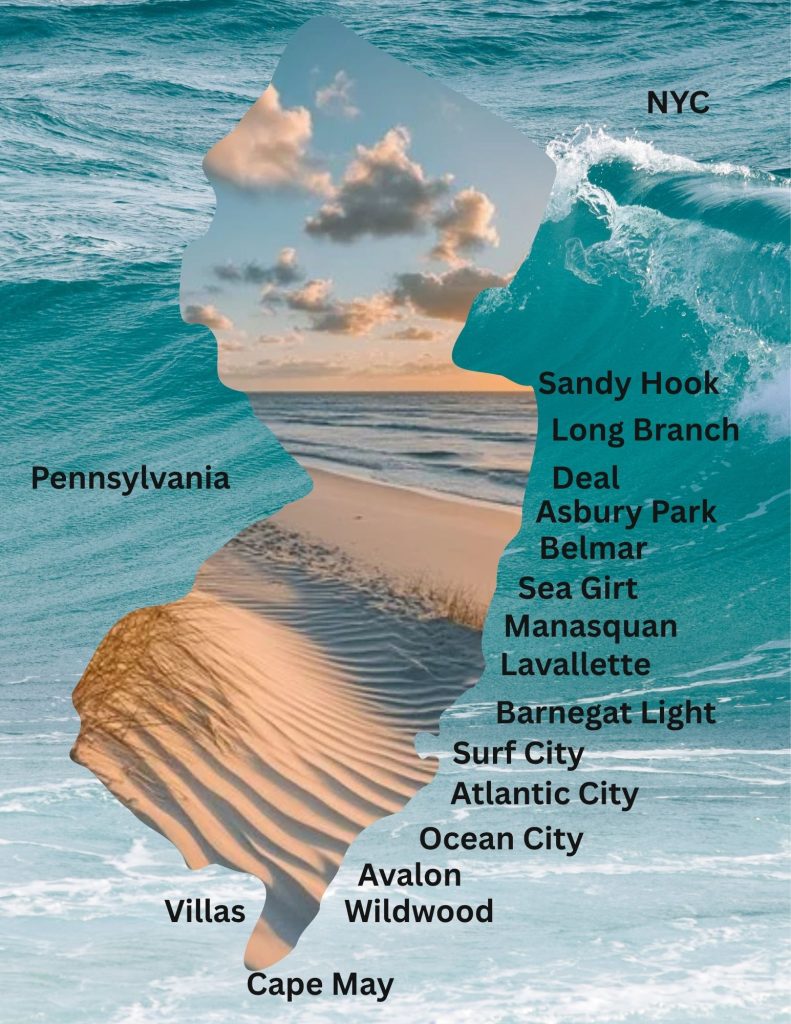
It is a place of contrasts. In winter, the beaches fall quiet, the horizon stretching wide and empty. In summer, they transform into vibrant centers of life. Yet beneath both seasons, something constant remains: the shore is always in motion, reshaped again and again by forces far older than human memory. What appears permanent is, in reality, temporary.
T he Jersey Shore is not simply a line where land meets ocean. It is a complex coastal system that includes not only the Atlantic-facing beaches but also sheltered inland waters like Barnegat Bay and Great Bay, where life moves to a slower, more protected rhythm. Between Memorial Day and Labor Day, these coastal communities swell dramatically with seasonal residents as retirees seeking quiet, young buyers drawn to the shore lifestyle, and generations of families returning to familiar places. Grand mansions stand beside modest homes, reflecting a wide spectrum of life. At the same time, a quiet tension exists between preservation and development, as environmental concerns meet the pressures of growth along this fragile coastline.
A Coast Formed by Ice and Constant Change
The story of these beaches begins thousands of years ago, at the end of the last Ice Age. As glaciers melted and sea levels rose, sand was pushed inland, forming long, narrow barrier islands that stretch the length of the state. These islands, separated from the mainland by marshes and bays, created the foundation of the Jersey Shore.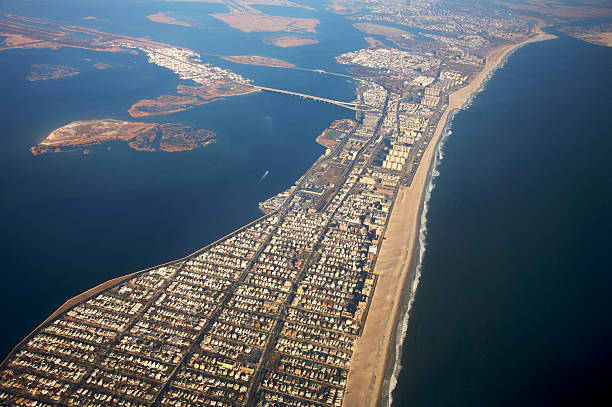
But unlike rocky coastlines, this land was never meant to stand still.
Storms, tides, and ocean currents continually reshape it. A single major storm can move entire dunes or shift the shoreline itself, sometimes relocating vast amounts of sand in a matter of hours. Inlets open and close. Shorelines advance and retreat. Erosion and replenishment are not unusual events—they are part of a continuous natural cycle.
For this reason, the New Jersey coast is not a fixed geography. It is a moving landscape, one that presents both beauty and challenge. To build here is to work against nature, and to protect it requires constant effort.
The First People of the Shore
Long before European settlement, Native American groups, especially the Lenape, lived with this changing environment. They did not attempt to control it; instead, they adapted to it, moving seasonally between inland forests and coastal waters.
The shore wasn’t a vacation spot. It was part of a cycle of movement tied to food, seasons, and trade. They fished, harvested shellfish, and traveled established routes that connected land and sea. Shell middens, thousands of years old, remain as quiet evidence of their presence. Even today, place names like Manasquan preserve echoes of their language, recalling a time when the shore was not a destination, but part of a living system of survival and movement. Manasquan is a good example of a time when people did not shape the land, but learned how to follow it. When they named it Manasquan, which means a “place to gather…”, it was not about ownership but about function. It reflects how Native people saw land as something to use, move through, and respect, not divide and settle permanently. Even today, the landscape of rivers, inlets, and barrier islands still behaves the way it did when the Lenape named it.
From Isolation to Opportunity
When European settlers arrived in the 1600s, they saw the barrier islands differently. To them, the shore was not inviting. It was harsh, exposed, and unpredictable. Wind, isolation, and flooding made it an undesirable place to live.
For centuries, the coastline remained largely avoided.
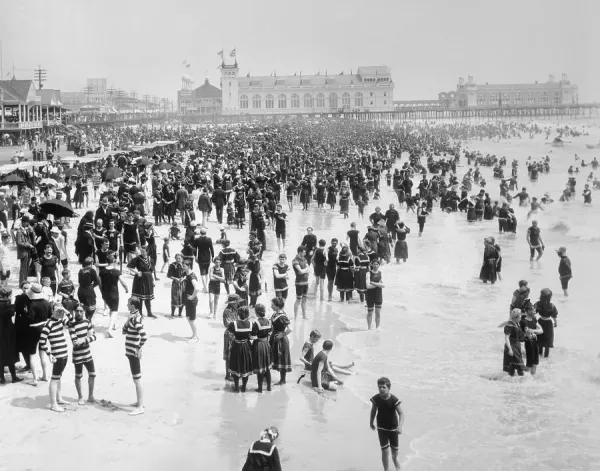 That perception began to change in the 19th century, as attitudes toward the ocean shifted. What had once been seen as dangerous began to be viewed as beneficial. The idea that sea air could improve health gained popularity after the physicians began prescribing what they called “sea bathing” and coastal stays for patients suffering from respiratory illnesses, fatigue, or what they described as “nervous conditions.” Places along the Jersey Shore became informal health destinations, and the shore slowly transformed from wilderness into retreat.
One of the earliest and most significant developments took place in Cape May, which emerged as one of America’s first seaside resorts. Soon after, Atlantic City rose rapidly, particularly after railroads connected it to inland cities. These rail lines made the shore accessible in a way it had never been before, opening it to large numbers of visitors.
Originally founded as a resort in 1830 and officially established as a city in 1853, Atlantic City quickly became the center of this transformation. By the late 19th century, it stood as the crown jewel of the Jersey Shore.
The Boardwalk and the Birth of Coastal Culture
In 1870, a mile-long wooden walkway from the beach into the town was erected to solve a problem not anticipated by the Town’s developers in the building of this seaside resort and tourist destination: beach sand. Wealthy visitors could walk out of their posh resort hotel with ocean views and onto the beach, but they didn’t want to take off their shoes and walk on the sand. 
Hoteliers on the beach were tired of guests dragging sand into their lobbies and guest rooms. Even train operators complained of sand in their cars after an Atlantic City run. It was a problem that needed to be managed for the sake of the tourist trade.
This practical solution led to an unexpected cultural invention. To keep sand out of hotels and train cars, Atlantic City built the first boardwalk. What began as a simple structure became something far greater.
The boardwalk evolved into a place of gathering, entertainment, and commerce. Shops, food stands, amusements, and piers transformed the shoreline into a destination in itself. It introduced a new kind of public space—one that blended leisure, architecture, and ocean views.
Visitors came in growing numbers. Philadelphia’s professional class was among the first, followed by others as access improved. Grand hotels and rooming houses lined the shore, catering initially to the wealthy, including figures such as Ulysses S. Grant and James A. Garfield. Artists like Winslow Homer captured scenes of coastal life, preserving its early atmosphere.
 At the same time, Atlantic City expanded its attractions. The first organized beach patrol appeared in 1881, as crowds began pouring into Atlantic City, the ocean quickly revealed its danger. Strong currents, sudden drop-offs, and inexperienced swimmers led to frequent drownings. In response, the city created what is considered one of the first organized lifeguard services in the United States, the Atlantic City Beach Patrol. This wasn’t just a few watchful individuals. It was a structured, disciplined force dedicated to protecting thousands of swimmers every day. The Atlantic City Beach Patrol helped define modern lifeguarding through constant surveillance, the development of rescue techniques, and physical conditioning.
One of their most recognizable tools became the rowboat, used to reach struggling swimmers quickly beyond the breakers, which was something unique compared to many other beaches at the time.
Over time, this led to competitions and traditions, including what would grow into the famous South Jersey Lifeguard Championships, sometimes called the “Dutch Hoffman,” where patrols compete in rowing, swimming, and rescue drills.
While being a lifeguard in Atlantic City became a prestigious role, saltwater taffy, ice cream stands, animal acts, and large piers drew massive crowds. Tourism flourished, and entrepreneurs benefited most from this rapid growth. Meanwhile, local working-class populations continued to rely on farming, fishing, shellfishing, and industries such as glassmaking, creating a layered and diverse coastal economy.
A Chain of Distinct Communities
As development spread, the Jersey Shore became something unique: a continuous line of towns, each with its own identity.
By the late 1800s and early 1900s, places like Asbury Park emerged as centers of entertainment and music, while Ocean Grove developed as a religious community with a quieter atmosphere. As railroads and ferry connections expanded, visitors from New York and northern New Jersey joined those from Philadelphia, further increasing the shore’s popularity.
Local services grew alongside this expansion. Fire departments, police forces, and small industries developed to support the growing populations.
What made these beaches especially appealing was their physical character. The sand was soft and light-colored, and the ocean floor sloped gently, making the water more accessible and swimmable than steeper coastlines. This natural advantage helped establish the Jersey Shore as a major vacation destination.
Today, more than 50 towns line this coast, forming a dense and varied chain of communities. Beyond the oceanfront lies the quieter Bay Shore region, where waters like Barnegat Bay, Sandy Hook Bay, and Great Bay support a different pace of life.
Growth, Conflict, and a Changing Nation
Between 1906 and 1929, the Jersey Shore reflected broader national changes. While it remained a place of leisure, it also became increasingly connected to global events. 
As tensions rose in Europe, the coast became strategically important. The U.S. Coast Guard increased patrols, and the Sea Girt Militia Training Center trained soldiers for modern warfare. Sandy Hook, long a site of observation and weapons testing, became a key defensive position guarding New York Harbor.
After the war, the 1920s brought renewed energy. Atlantic City embraced expansion, promoting itself as “bigger and better.” New attractions—moving pictures, parades, concerts, and political rallies—drew visitors. The Miss America pageant became a defining tradition.
Advances in infrastructure improved access, as automobiles, roads, and railways connected more people to the coast. Even so, natural disasters remained a constant threat. Fires, hurricanes, and events like the 1927 Ocean City fire demonstrated the vulnerability of these communities, reinforcing a culture of resilience.
Depression, War, and Adaptation
Between 1930 and 1949 The Great Depression brought economic hardship, and tourism declined. Yet the shore’s communities endured. Smaller towns, with limited industrial dependence, avoided some of the worst job losses, though agricultural areas faced greater strain.
With the onset of World War II, the coast once again became critical. Sandy Hook strengthened defenses against German U-boats, which operated just offshore and targeted Allied shipping. The area also served as a staging ground for troops heading to Europe.
Further south, the Cape May–Wildwood region became a center of military activity, including coastal defense systems and flight training facilities. Daily life changed as agriculture expanded to support the war effort, creating opportunities for women and minorities. Coastal blackouts began in 1942, reflecting the real threat just beyond the shoreline.
When the war ended, the region stood ready for renewal.
The Postwar Boom and the Rise of Shore Life
When soldiers came home and the war ended in 1945, America entered a period of growth and optimism. Families had more income, more free time, and, most importantly, mobility, allowing millions to reach the coast quickly and easily thanks to the opening of the Garden State Parkway in 1954, along with the rise of the automobile. Getting to the shore became easier than ever. Then 1950s marked a turning point. Travel patterns shifted. Air travel opened distant destinations, and the shore increasingly relied on working-class visitors. New attractions grew in places like Seaside Heights, Point Pleasant Beach, and Wildwood to attract those people. The Jersey Shore became a destination for working and middle-class Americans.
Smaller communities such as Lavallette and Ortley Beach saw rapid development, with rows of cottages offering affordable summer living.

For many families, the shore became a tradition—returning year after year, building memories tied to specific places.
Atlantic City struggled economically, highlighted during the 1964 Democratic National Convention. Asbury Park faced decline and unrest, including riots in 1970.
Rapid development of 1950s brought consequences. Overbuilding, water pollution, traffic congestion, and infrastructure strain forced communities to confront the limits of growth. Preservation efforts followed, protecting thousands of acres and creating state parks. The challenge became clear: how to balance expansion with sustainability.
Holding Back the Ocean
Today, the shoreline is carefully managed. The U.S. Army Corps of Engineers leads large-scale beach replenishment and dune restoration projects to protect coastal communities. The sand used to rebuild beaches is typically taken from offshore deposits located a few miles out, where engineers identify underwater sand reserves on the continental shelf. In some cases, sand is also dredged from inlets to keep waterways and shipping channels navigable.
The process, known as beach nourishment, involves moving sand from offshore back onto the shoreline in a carefully controlled way. A specialized dredging ship, often a hopper dredge, collects sand from the ocean floor and mixes it with water to form a slurry. This mixture is then pumped through pipelines, sometimes stretching for miles, onto the beach. Once the sand arrives, bulldozers and graders shape it to resemble a natural shoreline. The goal is to restore a wide beach and build a protective dune system that helps shield coastal communities from storms and erosion.
Yet the balance remains fragile.
Beach nourishment projects are carefully timed to minimize disruption and protect the environment. Most work takes place from fall through early spring, avoiding the busy summer tourism season and reducing impacts on wildlife during nesting periods. Projects may also be scheduled after major storms, such as hurricanes, when significant erosion has occurred. In many areas, nourishment follows a regular cycle, typically every three to six years, depending on how quickly the shoreline loses sand. Events like Hurricane Sandy demonstrate how quickly nature can reshape the coast, destroying infrastructure and altering landscapes in a few hours.
Despite engineering efforts, the shoreline remains a dynamic boundary between land and sea. Along the Jersey Shore, the story has never really changed.
Sand is always on the move.
“Where History, Heart, and Home Meet the Shore”
From the quiet, seasonal rhythms of the Lenape to the rise of grand seaside resorts and the glow of boardwalk lights, the beaches of New Jersey have always inspired awe and gratitude for their history. Over centuries, they have nourished communities, inspired art and song—Bruce Springsteen captured it perfectly, painting vivid scenes of boardwalk nights, summer love, and the restless energy of youth chasing freedom along these sands. His music reminds us that the Shore is more than a place; it is a feeling, a memory, and a connection to something timeless. Even today, physicians still praise the restorative benefits of fresh sea air. Cottages became homes, summer visits became lifelong traditions, and neighborhoods grew around the enduring charm of the coast. Every property tells a story, and every sale opens a new chapter. Whether you’re ready to pass your home on or find the perfect place to start your own shore story, there’s never been a more meaningful time to embrace life by the sea.