The Axis That Reoriented New Jersey
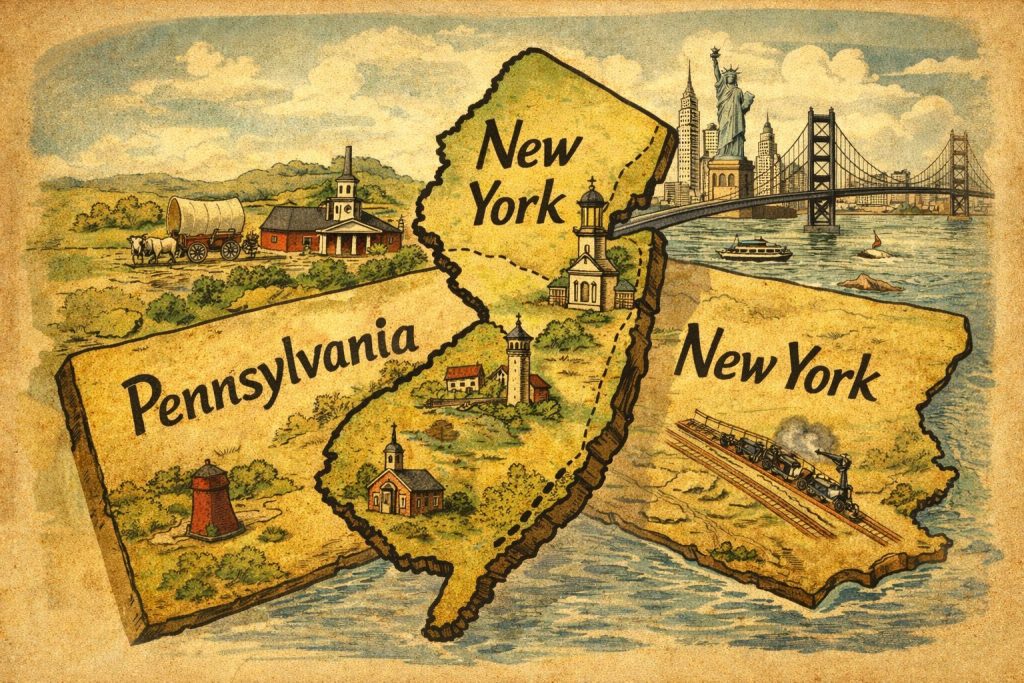 No governor announced it, no legislature approved it, and no mapmaker redrew the border. Yet between 1850 and 1920, New Jersey quietly rotated — not physically, but economically. The state stopped thinking in terms of East and West and began aligning itself from North to South. The shift was driven not by politics, but by proximity: to the financial power of New York City in the north and the commercial rhythm of Philadelphia in the south. Railroads, highways, and commuting patterns reshaped daily life, and real estate began responding not to geography but to momentum.
How did it start?
Even after East and West Jersey united in 1702, economic life continued to follow an east–west pattern because rivers served as highways. But with the coming of railroads, a development pioneered in the state. New Jersey became a leader in railroad construction. In the beginning, it operated as a horse-drawn line linking Philadelphia and Manhattan. The state’s first steam locomotive, the John Bull, went into service on the C&A. This company, “Camden & Amboy”, merged with “Delaware&Raritan Canal” and became a joint company and received a monopoly from the state in 1832, controlling transportation in the state. The railroad carried passenger and lighter freight, and the canal moved heavier freight. By 1840, ferryboat connections enabled passengers to ride from Philadelphia to New York.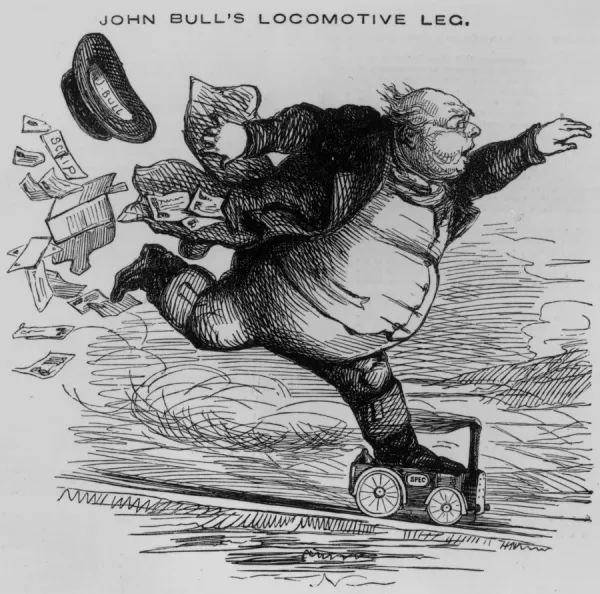
As coal was discovered and industrial demand increased in the mid-1800s, new railroad lines were steadily added across New Jersey. These were not random expansions — they were economic arteries. It was not only coal and freight moving through New Jersey’s expanding rail network — it was also commuters.
Lines connected the coal fields of Pennsylvania to the ports of New York City and Philadelphia, moving fuel to factories, foundries, and shipping terminals. Rail companies such as the Pennsylvania Railroad and the Central Railroad of New Jersey expanded aggressively during the 1850s–1880s, creating strong north–south corridors.
At the same time, rail access opened New Jersey’s shoreline. Resort towns along the Jersey Shore — including Atlantic City and Long Branch — became reachable to urban populations. What had once been isolated coastal settlements turned into major seasonal destinations because trains could bring thousands of visitors directly from the cities.
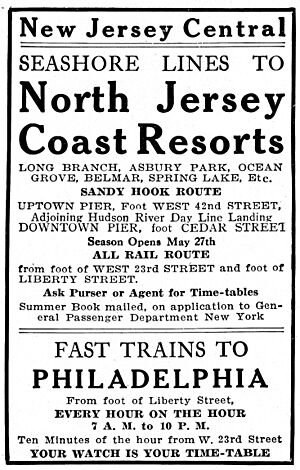 By the late 19th century, the growing rail network had quietly reoriented the state. Rivers no longer determined movement, but rail corridors did. And those corridors ran vertically — binding North Jersey more tightly to New York, and South Jersey more tightly to Philadelphia.
That is how the axis shifted.
New Jersey stopped functioning as two halves facing outward…and began functioning as a vertical corridor between two major cities, and Central Jersey became a connector corridor
By the late 19th century, property was no longer priced by acreage. It was priced by the minute in New Jersey. Entire towns began advertising not how large the lots were, but how quickly a resident could reach Manhattan. Real estate brochures in places like Montclair and Summit listed commute times in bold print.
This was revolutionary.
Land had always been valued for what it contained. Now it was valued for how fast it connected. That psychological shift alone reshaped North Jersey permanently.
The South Built a Different Economy
Imagine South Jersey in the 1700s; farmers in Burlington and Salem loading barrels of flour onto boats, sending them down the Delaware River to the Caribbean and coming back with rum and molasses. These farms were running an international trade from their own backyards! 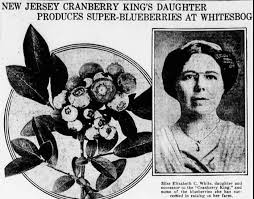

The sandy soils of the Pine Barrens looked useless, but locals turned them into the birthplace of America’s cranberry industry. It started with Elizabeth White, the daughter of a cranberry farmer in Hammonton in the late 1800s and early 1900s. Her family owned large cranberry bogs, and she knew a lot about cultivating native plants. She reached out to Frederick Coville, a botanist with the U.S. Department of Agriculture, who had been experimenting with improving wild plants. Together, they spent years carefully selecting the best berries, planting their seeds in prepared soil, and experimenting with cross-pollination. Coville discovered that blueberries need acidic soil, proper drainage, and careful pruning to grow consistently. Elizabeth helped by providing the land, observing wild growth patterns, and figuring out how to scale the process for commercial farms.

South Jersey’s tomato has also become a small legend of its own. It was a perfect mix of place, history, and flavor that locals treat almost like a seasonal celebration. The region’s sandy, well‑drained soils and warm coastal climate create tomatoes that are famously sweet, deeply aromatic, and balanced with just the right acidity. Generations of farmers have shaped this reputation, from early seed breeders to the canning giants like Campbell’s and Heinz, who once relied on New Jersey fields for their richest, most flavorful harvests. South Jersey became America’s tomato powerhouse, shipping millions of pounds of canned tomatoes by rail to hungry cities. This tomato is really a story about flavor, soil, and heritage. It’s a regional icon shaped by the sandy soils of the Pine Barrens, generations of family farms, and a culture. The exceptional sweetness of tomatoes is thanks to the warm days and cool nights, which concentrate sugars. “Jersey tomato” became famous of deep, balanced acidity, thin, tender skins ans an old‑fashioned tomato aroma described as “how tomatoes used to taste.”
Another famous variety, the Ramapo tomato, was bred at Rutgers in 1968 for its flavor and disease resistance and became a staple of Jersey farms. South Jersey’s tomato culture is rooted in multi‑generation family farms, many of which still operate today. on more than 100 acres.
These farms sit between Philadelphia and the Shore — a perfect corridor for roadside stands, farmers markets, and CSA programs that make tomatoes a summer ritual for locals.The Jersey tomato isn’t just produce — it’s part of the state’s identity. Ideal sandy, well‑drained soils , warmer climate creating unforgettable tomato flavor and longer growing season than North Jersey,Large multi‑generation farms concentrated in Gloucester, Salem, and Cumberland counties and Proximity to packing, processing, and distribution hubs all madev companies like Campbell’s historically sourced tomatoes from this region.
South Jersey’s agricultural landscape has always been more than fields and farmstands — it’s a living reminder that the best things grow from strong roots. The same sandy soils that give Jersey tomatoes their famous sweetness also support generations of family farms, roadside markets, and a culture built on care for the land. That spirit shapes the communities here just as much as it shapes the produce: grounded, welcoming, and full of character. In real estate, those qualities matter. People aren’t just choosing a house — they’re choosing a place with a heartbeat, a region where heritage and everyday life blend naturally. South Jersey’s agriculture tells that story beautifully: a place where tradition thrives, flavor is celebrated, and home still feels like something grown, not manufactured.
The South was not “behind.” It was specialized. Large tracts of preserved land, agricultural zoning, and later Pine Barrens protections kept development patterns fundamentally different from the north’s density model.
Two regions.
Two growth formulas.
Economic Fault Line Without a Border
There’s no physical border dividing North and South Jersey. But businesses and investors began treating it as if there was one — because the money patterns became different. Insurance companies, transportation planners, and even early 20th-century investors began modeling New Jersey as two separate economic zones.
North Jersey became tightly connected to New York City when Manhattan built more offices, and more people needed housing nearby. That increased demand in places like Newark, Jersey City, and surrounding counties. North Jersey’s economy rose and fell with New York’s business cycle
South Jersey moved in sync with Philadelphia when Philadelphia’s factories expanded, and port activity increased; South Jersey’s land and industry grew. Farm prices, industrial land, and development followed Philadelphia’s manufacturing economy.
Gradually, a split in economic gravity was created, not because people argued, but because money and jobs flowed in two different directions. It wasn’t about culture, accents, or sports teams. It was about commuting patterns, investment patterns, land values, and business cycles. “Synchronized economics” made each half of the state move in rhythm with a different major city’s economy.
No law created that division. No governor announced it. It just happened because proximity to two powerful cities reshaped the state’s internal structure.
51st State? The day South Jersey voted to leave New Jersey and secede never happened.
 Over the decades, there were serious and repeated discussions about dividing New Jersey. Legislators floated proposals. County leaders debated autonomy. Voters in some southern counties even supported referendums exploring separation in the late 20th century. And yet, it never became another North Dakota and South Dakota. It never split like North Carolina and South Carolina.
It never fractured like Virginia and West Virginia. Because those states are divided over governance, war, or territorial expansion. New Jersey’s North and South emerged simultaneously — not as enemies, but as counterparts. They grew in parallel. The ports of Newark depended on agricultural supply chains. Southern tourism relied on northern population density. Highway funding, utility grids, and tax systems were economically intertwined. The identity diverged. The infrastructure is unified. That distinction is critical.
The Real Estate Reality Today
When you choose North Jersey, you are choosing a dense environment with closer development, faster business cycles, quicker transactions, corporate growth, finance, and real estate tied to high-rise economies and being close to Manhattan’s capital flow. It is a concentrated, fast-moving, finance-driven power.
When you choose South Jersey, you are choosing to live in wide-open areas that convey freedom and distance between things, preservation of farmland, historic towns, protected land, shoreline access that promotes tourism cycles, and a market that moves in rhythm with Philadelphia and seasonal coastal economies. This is land-based, lifestyle-driven, port-and-shore-influenced power
Neither is secondary. They are complementary forces inside one compact state. New Jersey evolved like a hinge, holding two powerful economic worlds together. And in real estate, that hinge creates opportunity. North and South New Jersey are not competitors — they are two currents in the same river of opportunity. Together, they create one of the most strategically positioned real estate environments in America.
That is not geography.
That is leverage.
When you buy in New Jersey, you are not simply selecting a property.
You are aligning with an economic current that has been forming for over a century.
My role is not just to show homes. It is to interpret direction. To understand which force — northern velocity or southern expansion — fits your ambitions, your lifestyle, and your long-term investment goals.
Because in this state, direction is never random.
It is deliberate.
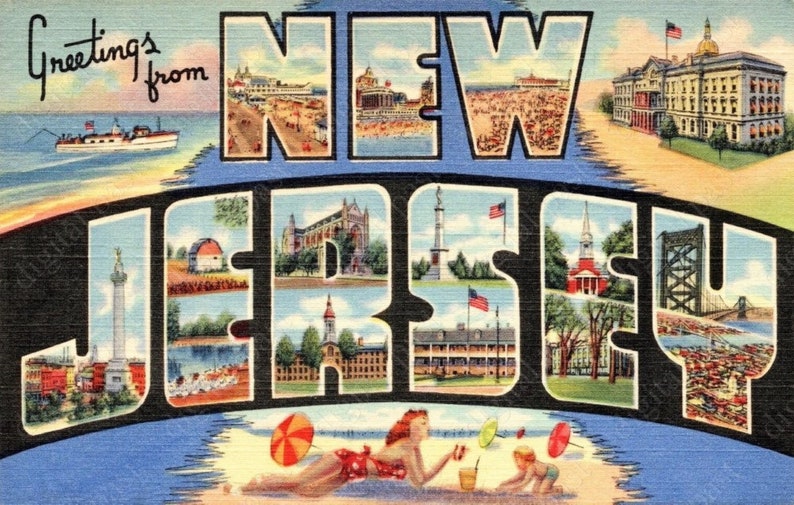
“As industry boomed and railroads stitched the state together, New Jersey’s map of identity adjusted
from East and West to North and South.”
The terms North Jersey and South Jersey became common in conversation, newspapers, and travel guides with the rise of railroads, industry in the north (Newark, Paterson, Jersey City), and agriculture in the south (farmland, Pine Barrens).
New Jersey was once understood as East and West, a reflection of how rivers carried goods, people, and influence across the land. Those lines softened and multiplied, revealing six distinct faces, each with its own character. As cities grew and daily life shifted away from waterways, the state’s sense of direction changed with it.